TAMPA WATER FILTRATION SERVICES
365 Days Emergency Service Across Hillsborough, Pinellas, and Pasco
- Tampa | St. Petersburg | Clearwater | Brandon | Wesley Chapel
- Whole-House Water Softeners & Filtration Systems
- Protect water heaters, fixtures, and water pipes.
- Residential & commercial | Emergency Service
WHAT IS HARD WATER AND WHY IS TAMPA BAY’S SO HARD?
Quick answer: Tampa Bay tap water typically measures 200–300 mg/L (11–17 grains per gallon) in Hillsborough County — a level the USGS classifies as very hard to extremely hard. The source is the Floridan Aquifer, one of the most mineral-rich groundwater systems in North America.
Hard water is water that contains elevated concentrations of dissolved calcium and magnesium. As rainfall filters through Florida’s porous limestone bedrock and into the Floridan Aquifer, it dissolves calcium carbonate and magnesium bicarbonate at concentrations most of the country never experiences. By the time that water reaches a Tampa Bay tap, it carries mineral loads that the EPA’s ideal range of 60–120 mg/L doesn’t come close to covering.
Tampa Bay hardness by county:
- Hillsborough County: ~200–300 mg/L (11–17 GPG) — Very Hard
- Pinellas County: ~150–250 mg/L (9–15 GPG) — Hard to Very Hard
- Pasco County: ~200–350 mg/L (11–20 GPG) — Very Hard to Extremely Hard
For comparison, the USGS defines hard water as anything above 7 GPG. Tampa Bay starts there and keeps going.
The result is scale — mineral deposits that accumulate on every surface water touches inside your home. Not eventually. Continuously. Every pipe, every fitting, every appliance, every fixture. The question isn’t whether Tampa Bay water causes damage without treatment. It’s how much has already accumulated.
Easy monthly payment options made available by EVERYDAYPLUMBER.com — ask about payment options when you call.
TYPES OF WATER TREATMENT SYSTEMS WE INSTALL
Quick answer: The four primary treatment types for Tampa Bay homes are salt-based water softeners (removes calcium and magnesium via ion exchange), salt-free water conditioners (neutralizes scale formation without removing minerals), whole-house carbon filtration (removes chlorine, chemicals, and organics), and reverse osmosis systems (removes 95–99% of dissolved solids at the point of use). Most Tampa Bay homes need a combination of softening and filtration — not one or the other.
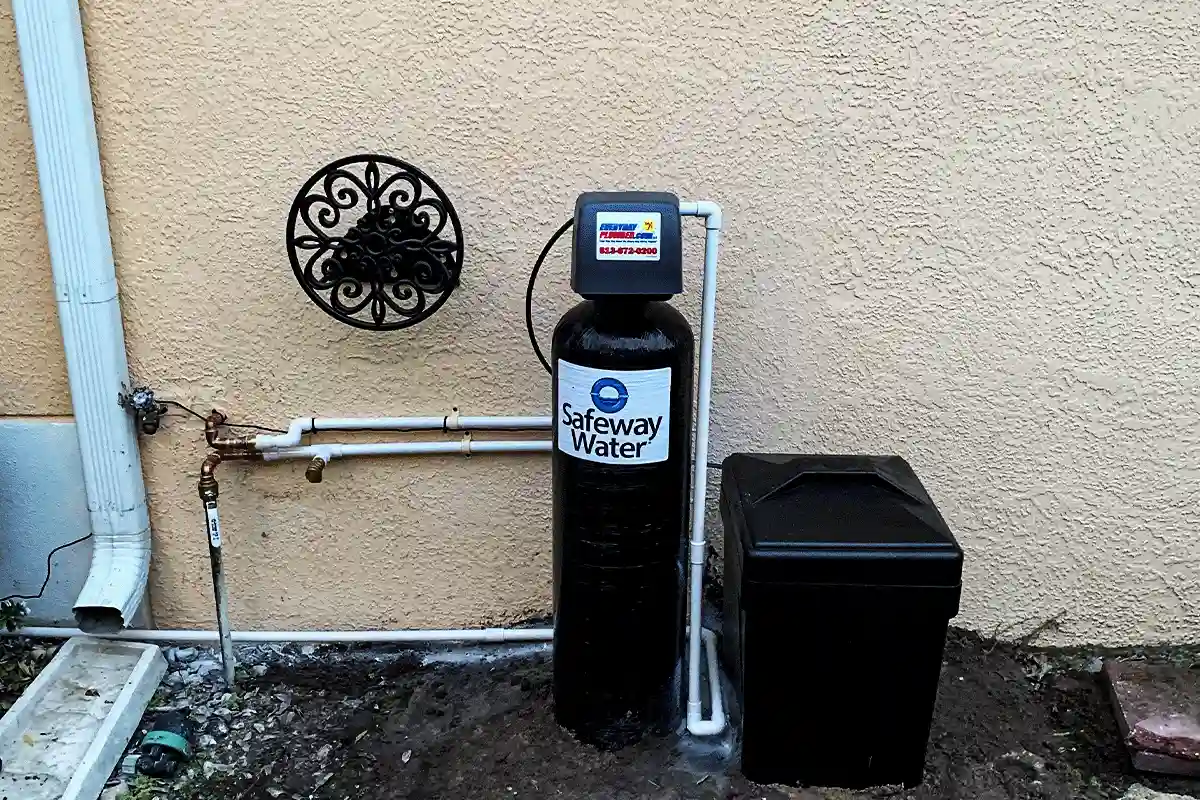
- Salt-Based Water Softeners The proven standard for Tampa Bay’s hard water. Ion exchange resin removes calcium and magnesium ions before they reach any pipe, fixture, or appliance. Eliminates scale formation. Requires periodic salt refills. Best for any home measuring above 10 GPG — which in Tampa Bay means virtually every home.
- Salt-Free Water Conditioners (TAC Systems) Changes the crystalline structure of calcium and magnesium so scale can’t adhere to surfaces. Minerals stay in the water — TDS is unchanged — but scale stops forming. No salt, no electricity, no regeneration cycles. Best for homeowners with sodium dietary restrictions or where brine discharge is a concern.
- Whole-House Carbon Filtration Installs at the point of entry. Removes chlorine, chloramines, VOCs, sediment, and organic compounds from all water entering the home. Improves taste and odor at every tap. Protects fixture rubber seals and gaskets from chloramine degradation. Commonly paired with a softener.
- Reverse Osmosis (RO) Drinking Systems Under-sink installation connected to a dedicated faucet. Forces water through a semi-permeable membrane that removes 95–99% of dissolved solids — lead, arsenic, nitrates, fluoride, chromium-6, pharmaceuticals. The highest-purity drinking water option available for residential use.
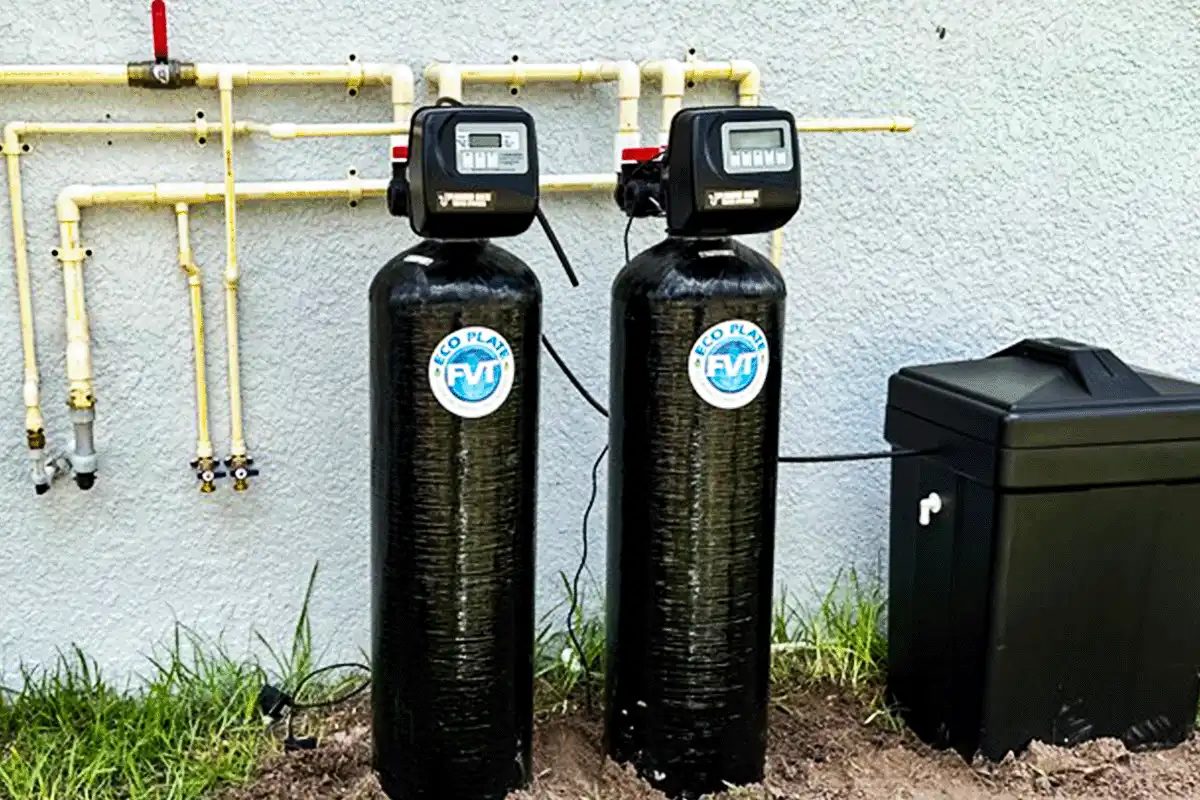
- Combination Systems The Tampa recommendation: a whole-house salt-based softener paired with a carbon pre-filter at entry, plus an RO system under the kitchen sink. Addresses scale damage throughout the home and provides pure drinking and cooking water. One installation — every meaningful water quality problem solved.
WHAT & WHERE WE SERVICE
EVERYDAYPLUMBER.com installs and services whole-house water softeners, water filtration systems, reverse osmosis drinking systems, and commercial water treatment equipment throughout Tampa Bay.
Residential service covers every home type — single-family, condominium, townhouse — regardless of plumbing age. Whether your home has decades of existing scale or you’re in new construction that hasn’t started accumulating yet, we size the right system for your specific hardness level and household consumption.
Commercial service covers restaurants, multifamily properties, gyms, office buildings, and light industrial facilities that require higher-capacity systems, NSF-certified components, and service agreements.
We serve customers across Hillsborough County, Pinellas County, and Pasco County — including Tampa, Brandon, St. Petersburg, Clearwater, Wesley Chapel, Land O’ Lakes, Lutz, Carrollwood, Westchase, New Tampa, and all surrounding communities. Emergency services available — call our friendly office staff at 813-872-0200 or book online.
WHAT HARD WATER IS DOING TO YOUR HOME RIGHT NOW
Every day without water treatment, hard water is degrading your plumbing, shortening appliance life, and accumulating scale that won’t flush out on its own. The damage isn’t dramatic — it’s slow, consistent, and expensive by the time it becomes visible. Here’s where it hits first.
YOUR WATER HEATER
In short: Hard water is the leading cause of premature water heater failure in Tampa Bay. Scale insulates the heating element, forces the unit to run longer to reach temperature, and shortens tank life by 3–7 years.
Calcium and magnesium settle as sediment at the bottom of your water heater tank. That layer of mineral deposit acts as insulation between the burner and the water. The heater compensates by running longer — you’ll hear it as the popping and rumbling during heating cycles. That sound is scale cracking as it expands and contracts with heat. It means the damage is already underway.
Tankless water heaters are more vulnerable, not less. Scale accumulates in the heat exchanger — the narrow internal passages where heat and water exchange. When those passages begin to restrict, the unit works harder, eventually overheats its safety sensors, and locks out. In Tampa Bay, scale in the heat exchanger is the primary reason tankless units fail before their expected lifespan — not wear, not installation error. The water.
A whole-house water softener stops scale accumulation across all water heater types from the day of installation. Tankless units benefit most.
YOUR PIPES & FITTINGS
In short: Scale builds up inside pipe walls over years, narrowing internal diameter and reducing flow. In older copper plumbing, hard water also accelerates corrosion at joints and fittings — contributing to pinhole leaks.
This damage is invisible until it manifests as reduced pressure, discolored water, or a leak. Homes built before 2000 with original copper plumbing have been accumulating scale for decades. Scale doesn’t dissolve or flush out on its own. It compounds. The narrower the pipe, the higher the velocity of water through the restriction — which accelerates further corrosion.
If your home is approaching a repipe conversation, hard water is part of why. If you’ve had pinhole leaks or pipe repairs in the last few years, treating the water prevents the next round.
YOUR FIXTURES & APPLIANCES
In short: Hard water damages fixtures visually, functionally, and permanently — and shortens the lifespan of every water-using appliance in your home.
The white and orange mineral rings that resist scrubbing in your toilet bowl — those are calcium and iron deposits from untreated hard water. The crust around your showerhead restricting flow — scale. The film on glassware after the dishwasher runs — mineral residue that no detergent fully addresses.
Beyond visible damage: dishwashers accumulate scale on the spray arm jets and heating element. Washing machines develop mineral deposits in the drum and water inlet valves. Coffee makers and ice makers have scale in every surface water contacts. Each of these fixture failures is accelerated by Tampa Bay’s hardness level.
YOUR SKIN, HAIR & LAUNDRY
In short: Hard water reacts with soap and shampoo to form calcium soap scum — reducing lather, leaving a film on skin, and making hair feel coated after washing. This is a chemical reaction, not a sensitivity.
Calcium and magnesium ions bind with the fatty acids in soap before they can clean. The result is reduced lather and a residue that doesn’t fully rinse. The dry, tight feeling after showering that many Tampa residents attribute to their skin type is a well-documented hard water effect — measurable and consistent.
Laundry washed in hard water loses softness and brightness over repeated cycles as mineral ions embed in fabric fibers. Detergent effectiveness is reduced, which means more product per load. Soft water restores both — typically within a week of installation.
RESIDENTIAL WATER SOFTENING & FILTRATION FOR TAMPA BAY HOMES
Tampa Bay homeowners have more water treatment options than most markets — not because the industry is more competitive here, but because the water is bad enough that the demand is real. Understanding what each system actually does is the starting point for making the right call.
SALT-BASED WATER SOFTENERS — THE STANDARD SOLUTION
Quick answer: A salt-based water softener is the most effective solution for Tampa Bay’s hard water. Ion exchange removes calcium and magnesium from your supply line before they reach any fixture, pipe, or appliance. This is the system category that eliminates scale formation — not reduces, eliminates.
How it works: water passes through a tank of resin beads charged with sodium ions. Calcium and magnesium ions bond to the resin. Sodium ions release into the water supply in their place. During regeneration cycles, the resin is flushed with brine and recharged. The process repeats continuously.
System sizing is the variable that determines performance. A family of four at 15 GPG hardness needs a materially different capacity than a single-occupant household. Undersized systems don’t fully treat the water. Oversized systems waste salt and regenerate unnecessarily. We size every system to your confirmed hardness measurement, household consumption, and plumbing configuration.
Salt refills: typically 40–50 lbs of pellet salt every 6–8 weeks for an average Tampa Bay household.
SALT-FREE WATER CONDITIONERS
Quick answer: Salt-free conditioners (Template Assisted Crystallization, or TAC) prevent scale without removing minerals. Total dissolved solids in the water are unchanged — but mineral ions are structurally altered so they cannot adhere to pipe walls, heating elements, or fixture surfaces.
Salt-free systems require no electricity, no regeneration cycles, and no salt purchases. They produce no brine wastewater discharge. Maintenance consists of media replacement every 5–7 years.
The distinction matters: salt-free systems prevent scale — they don’t soften the water in the technical sense. Water hardness on a test strip is unchanged. Appliance protection and pipe protection are achieved. The soap lather improvement and skin feel change that come with true softening are not present.
Best fit: homeowners on medically low-sodium diets, rental properties where ongoing salt management isn’t practical, or situations where water softener brine discharge restrictions apply.
WHOLE-HOUSE CARBON FILTRATION
Quick answer: A whole-house carbon filter installs at the main supply line and removes chlorine, chloramines, VOCs, sediment, and organic compounds from all water entering the home — before it reaches any tap, appliance, or water heater.
Tampa’s municipal water is treated with chlorine and chloramines. Both accomplish disinfection. Both also affect water taste, odor, and over time, degrade rubber seals and gaskets in faucets, valves, and appliances. Carbon filtration addresses all of this at the source.
Paired with a water softener, a carbon pre-filter also extends resin life by removing oxidizing agents that degrade ion exchange media. Most combination system recommendations include a carbon stage for this reason — it’s a system protector as much as a water quality upgrade.
Filter cartridge replacement: every 6–12 months depending on flow volume and source water chemistry.
REVERSE OSMOSIS DRINKING SYSTEMS
Quick answer: A reverse osmosis system installed under the kitchen sink removes 95–99% of dissolved solids from drinking and cooking water — including lead, arsenic, nitrates, fluoride, chromium-6, and pharmaceuticals. It connects to a dedicated faucet and produces the highest-purity drinking water available for residential use.
RO membranes force water through passages so small that dissolved ions cannot pass. What emerges is water with near-zero TDS. The difference in taste is immediate and significant — particularly in Tampa Bay, where high mineral content is detectable in unfiltered tap water.
RO systems address the one gap that whole-house softeners and carbon filters don’t fully cover: trace contaminants and dissolved solids at the glass. For drinking water and cooking, RO is the definitive answer.
Maintenance: membrane replacement every 2–3 years; pre-filter and post-filter cartridge replacement every 6–12 months.
THE TAMPA RECOMMENDATION — COMBINATION SYSTEM
For most Tampa Bay homeowners, the right configuration is a three-stage combination system:
Stage 1 — Carbon pre-filter at the point of entry. Removes chlorine and chloramines. Protects the softener resin. Improves taste and odor immediately.
Stage 2 — Whole-house salt-based softener. Removes calcium and magnesium from all water entering the home. Eliminates scale in pipes, water heaters, dishwashers, washing machines, and every fixture. Restores soap lather. Extends appliance lifespan.
Stage 3 — Under-sink reverse osmosis. Removes remaining dissolved solids, trace contaminants, and any residual sodium from the softening process. Pure drinking and cooking water at the kitchen faucet.
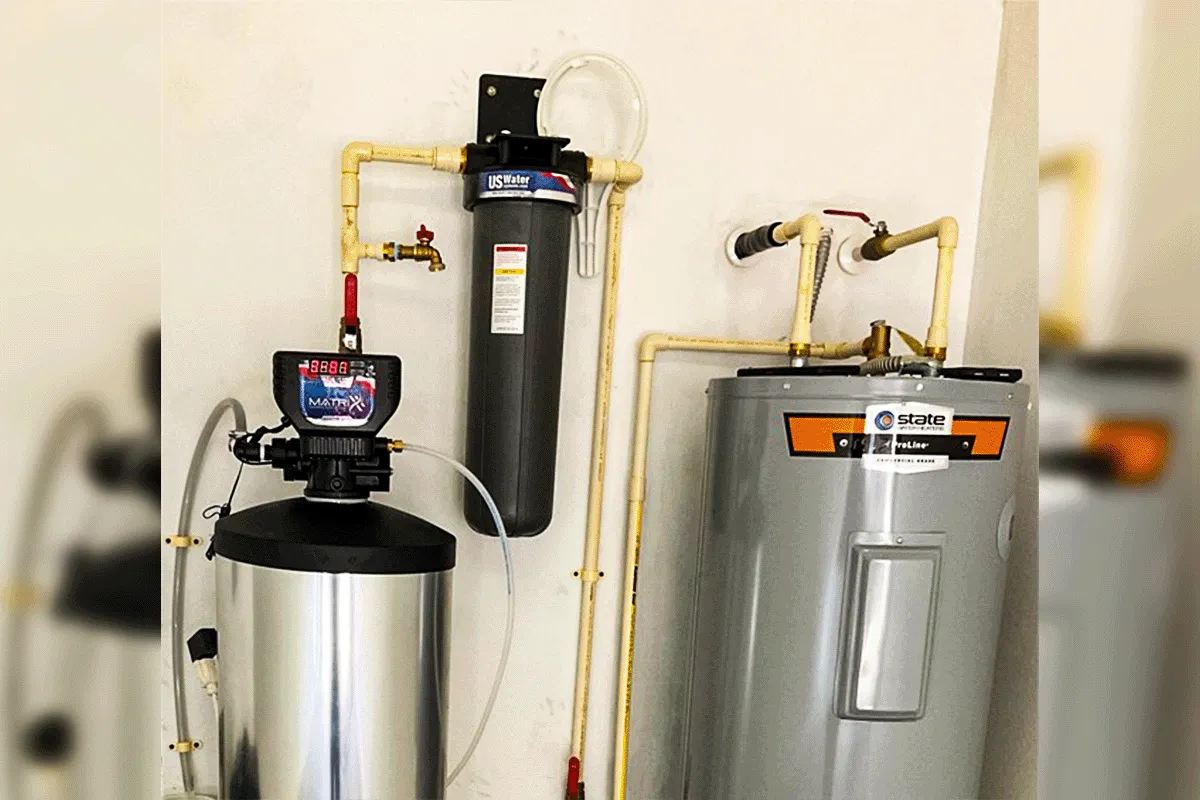
A note on water heaters: a whole-house softener is fully compatible with tank, tankless, and hybrid water heaters. Tankless units benefit most — scale accumulation in the heat exchanger is the primary failure mode for tankless systems in Tampa Bay, and soft water eliminates it.
COMMERCIAL WATER TREATMENT FOR TAMPA BAY BUSINESSES
Quick answer: Commercial water treatment in Tampa Bay requires higher-flow-rate systems, NSF-certified components, and service agreements built around operational schedules — because the cost of equipment failure, scale-related maintenance, and water quality issues in a commercial environment compounds far faster than in any residential setting.
Hard water doesn’t respect the distinction between a home and a business. For restaurants, apartment complexes, gyms, and office buildings operating in the Tampa Bay market, untreated water is a recurring line item — in equipment repairs, cleaning product consumption, maintenance labor, and shortened appliance lifecycles. The volume is higher. The cost per incident is higher. The fix is the same.
RESTAURANTS & FOOD SERVICE
Scale buildup in commercial dishwashers, espresso machines, ice makers, combi ovens, and steam equipment is an operational fact of life in Tampa Bay without water treatment — shorter equipment life, more frequent descaling, and chemistry costs that never end.
Beyond equipment: water quality affects the flavor profile of everything your kitchen produces. Coffee, ice, steam, and water used in food preparation all carry the mineral character of Tampa Bay’s municipal supply unless treated. NSF-certified commercial filtration and softening systems are standard in professional food service for this reason.
We install and service commercial systems sized for restaurant flow rates, with filter change schedules matched to your daily cover count and water volume.
PROPERTY MANAGEMENT & MULTIFAMILY
Scale damage across a 50-unit or 200-unit apartment complex isn’t one problem — it’s dozens of simultaneous problems accumulating in parallel. Sediment in water heater tanks across every unit. Clogged aerators generating maintenance tickets. Mineral buildup in shared supply lines and mechanical room equipment.
Building-level water softening addresses all of it at the source. One installation upstream of the building’s distribution system treats every unit. Maintenance tickets related to scale and mineral buildup drop. Water heater lifespans extend. Fixture replacement frequency decreases. For properties where water quality is a resident complaint, treatment is also a credible operational upgrade.
EVERYDAYPLUMBER.com has long-term commercial relationships with property management companies throughout Tampa Bay. Call to discuss what a building-level system looks like for your portfolio.
GYMS, FITNESS CENTERS & HOSPITALITY
Shower facilities, steam rooms, water fountains, and pool-adjacent plumbing systems are disproportionately affected by hard water. High-traffic shower facilities scale up showerheads and mixing valves faster than residential bathrooms. Steam rooms and saunas accumulate mineral deposits that require aggressive descaling unless the supply water is treated. Water fountains in high-calcium environments show mineral buildup around spouts.
We install commercial softening and filtration systems for fitness facilities that require high flow rates, consistent performance, and maintenance scheduling that doesn’t disrupt operations.
OFFICE BUILDINGS & LIGHT COMMERCIAL
Point-of-use filtration for break rooms and drinking stations. Building-wide softening for HVAC systems and restroom plumbing. Commercial RO systems for facilities with laboratory or specialty water purity requirements. We design and install water treatment systems for commercial properties across the full scope of need — from a single under-counter RO unit to a building-wide treatment system serving multiple floors.
Commercial accounts receive service agreements with scheduled maintenance visits, filter change records, and priority scheduling for service calls.
TAMPA BAY LOCALITIES AFFECTED BY HARD WATER
Quick answer: Tampa Bay’s water hardness ranges from approximately 9–20 grains per gallon depending on municipality and source — placing the entire three-county service area in the “hard” to “extremely hard” range by USGS classification. The source is the Floridan Aquifer, one of the most productive and most mineral-saturated groundwater systems in the world. No community in the Tampa Bay service area is exempt from hard water. Hardness levels vary — but the entire region warrants treatment.
USGS hardness classification:
- Soft: 0–60 mg/L / 0–3.5 GPG
- Moderately Hard: 61–120 mg/L / 3.5–7 GPG
- Hard: 121–180 mg/L / 7–10.5 GPG
- Very Hard: 181+ mg/L / 10.5+ GPG
Tampa Bay consistently falls in the Very Hard to Extremely Hard range. The EPA’s recommended drinking water hardness is 60–120 mg/L. Tampa Bay’s tap water typically doubles it.
HILLSBOROUGH COUNTY — APPROXIMATE HARDNESS 200–300 MG/L (11–17 GPG)
South Tampa / Hyde Park / Palma Ceia — Older plumbing infrastructure combined with sustained hard water exposure means decades of accumulated scale in copper pipes and fixtures. Higher-value homes make appliance protection particularly cost-justified.
Davis Islands — High-value properties with aging copper plumbing are most at risk for hard water accelerating corrosion at joints and fittings.
Westchase — Newer construction is not exempt. Scale accumulation begins at installation. Protecting a new water heater and new appliances from day one is the highest-ROI window for treatment.
Carrollwood / Northdale — Mid-century plumbing infrastructure with significant historical scale buildup throughout the community.
New Tampa / Tampa Palms — High-income, high-fixture-count homes where the cost of scale-related appliance replacement is most significant.
Valrico / Brandon — High residential density with consistent hard water impact across both older and newer construction.
Fish Hawk Ranch / Lithia — High-end new construction drawing from one of the harder zones in the Hillsborough aquifer system.
Plant City — Among the harder water zones in Hillsborough County. Higher-than-average hardness relative to the Tampa city baseline.
PINELLAS COUNTY — APPROXIMATE HARDNESS 150–250 MG/L (9–15 GPG)
Safety Harbor — The city’s famous mineral springs are a direct product of the same Floridan Aquifer that makes tap water hard. The geology that built Safety Harbor’s identity is the same geology that requires water treatment in every home here.
Dunedin — Older downtown properties and historic homes show consistent hard water wear on fixtures and plumbing.
Clearwater / Belleair — High-density residential with scale impact throughout the older plumbing stock.
Tierra Verde / St. Pete Beach — High-value coastal properties where appliance and fixture investment makes protection straightforward to justify.
St. Petersburg — Large and diverse residential base. Scale accumulation in older plumbing is widespread across every neighborhood.
Largo / Seminole — Consistent hard water throughout; high volume of residential softener installations relative to the county.
PASCO COUNTY — APPROXIMATE HARDNESS 200–350 MG/L (11–20 GPG)
Pasco County’s water hardness is among the highest in the Tampa Bay region. Several municipalities here draw from aquifer zones that produce hardness at the upper end of the regional range.
Wesley Chapel — One of Tampa Bay’s fastest-growing corridors. New construction at scale, with hard water from the day water first flows through new plumbing. The highest-return window for treatment is before scale has a chance to establish.
Land O’ Lakes / Lutz — Consistent very hard water; among the higher softener adoption rates in the region because the effects are pronounced.
Odessa — High-income community with significant fixture and appliance investment to protect. Scale damage here is expensive per incident.
Zephyrhills — Among the hardest municipal water in Tampa Bay. Worth noting: the nationally recognized bottled water brand bearing this city’s name draws from a separate source. The brand does not reflect the hardness of Zephyrhills tap water, which is consistently in the extremely hard range. Homeowners who assume otherwise based on brand association need a water test.
New Port Richey / Port Richey — Hard water throughout; significant older plumbing stock accumulating scale across the community.
HOW WATER SOFTENER AND FILTRATION INSTALLATION WORKS
Quick answer: The process has five steps — water test, system recommendation, installation, setup and programming, and ongoing maintenance. Most residential installations are completed in a single visit. The process starts with a water test, not a sales conversation.
We don’t arrive with a system in the truck and a script to sell it. We arrive with a test kit. Your hardness level, chlorine content, iron concentration, and any other relevant parameters are confirmed before any recommendation is made. The system type, size, and configuration come from those numbers — not from inventory pressure.
Step 1 — Water Test
We test your water at the tap. Hardness (GPG), pH, free chlorine and chloramine levels, iron content, and any other parameters relevant to your home. This takes approximately 15 minutes and produces specific, actionable numbers. It’s the only honest starting point.
Step 2 — System Recommendation
Based on test results, household size, and plumbing configuration, we recommend the right system type, capacity, and configuration. You’ll receive clear options at different price points. No system is recommended that the test results don’t justify.
Step 3 — Installation
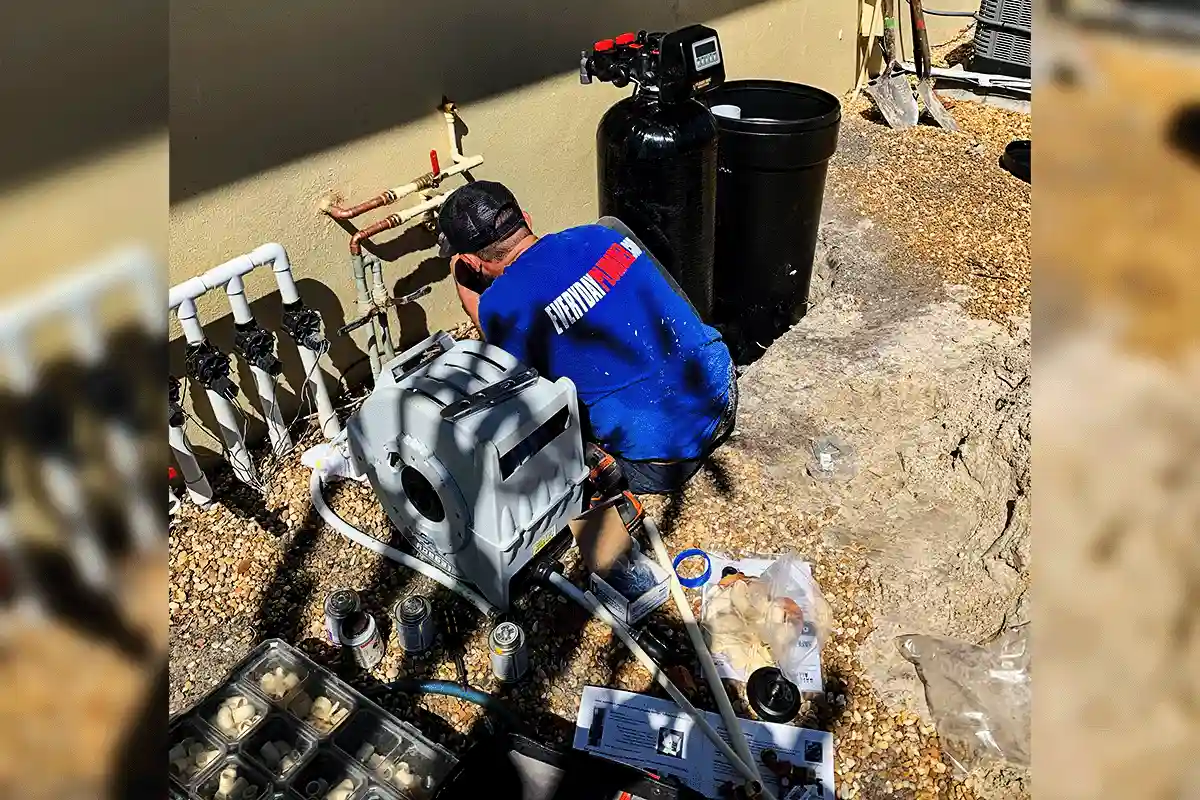
Most residential whole-house systems install in 2–4 hours. The system connects at the main supply line before it branches to your water heater and distribution system — treating all water entering the home. All connections are made to Florida plumbing code. Bypass valves, drain connections, and any electrical requirements are handled as part of the installation. We ensure compatibility with your water heater as well as the rest of your water piping system.
Step 4 — Setup and Programming
Salt-based systems are programmed to your confirmed hardness level and household consumption pattern. Regeneration cycle timing is set to minimize salt use and wastewater. We walk through system operation before leaving.
Step 5 — Ongoing Maintenance
Salt refills every 6–8 weeks for an average household. Carbon filter cartridge replacement every 6–12 months. Annual system inspection for resin health, brine valve function, and post-treatment hardness verification. Commercial accounts receive scheduled service agreements.
WATER SOFTENER MAINTENANCE AND WHAT TO EXPECT AFTER INSTALLATION
Quick answer: A properly installed and maintained salt-based water softener lasts 15–25 years. The primary ongoing requirement is salt refills every 6–8 weeks. Most Tampa Bay homeowners notice measurable changes in water quality within 24–48 hours of installation — in lather, feel, and the absence of new mineral deposits on fixtures.
WHAT CHANGES IMMEDIATELY
Within 24–48 hours of installation:
- Soap lathers more easily. Shampoo, dish soap, hand soap, and laundry detergent all perform differently in soft water — lather forms faster, rinses cleaner, and less product is needed per use.
- Showering and bathing feel different. The tight, dry residue that hard water leaves on skin is gone. Water rinses completely without a film.
- Dishes exit the dishwasher spot-free. Mineral film on glassware and flatware stops immediately.
Aerators and shower-heads stop accumulating new crust. Existing scale doesn’t dissolve overnight — but new accumulation stops from day one, and surface deposits on fixtures gradually diminish as soft water passes through.
SALT REFILLS AND ANNUAL SYSTEM CHECKS
For an average Tampa Bay household of four people at 14–15 GPG hardness, expect to add 40–50 lbs of high-efficiency pellet salt every 6–8 weeks. Salt use scales with water consumption and hardness level — households in Pasco County’s harder water zones may refill more frequently.
We recommend an annual system inspection: resin health check, brine valve inspection, regeneration program verification, and post-treatment hardness test at the tap. Systems that are correctly sized and maintained on schedule reliably achieve 20+ years of service life.
WHAT SOFT WATER MEANS FOR YOUR WATER HEATER
In short: Soft water stops all new scale formation in your water heater from the day of installation. If your tank already has years of sediment accumulation, a water heater flush before softener installation is recommended — it gives your heater a clean baseline to work from and extends the remaining service life.
Tankless water heaters running on soft water from installation will reach or exceed their rated service life. Tankless units already experiencing flow reduction from heat exchanger scale may require descaling service before benefits are fully realized.
FILTER AND MEMBRANE REPLACEMENT SCHEDULES
Carbon pre-filters: Cartridge replacement every 6–12 months depending on municipal water chemistry and household flow volume.
Reverse osmosis membranes: Every 2–3 years under normal residential use. Signs of early replacement need: reduced flow at the RO faucet, water taste change, or TDS meter reading that exceeds the system’s rated rejection rate.
RO pre-filters and post-filters: Every 6–12 months. These protect the membrane — neglecting them shortens membrane life significantly.
Salt-free conditioner media: Every 5–7 years before media replacement. No other ongoing maintenance required.
WATER FILTRATION AND SOFTENING — FREQUENTLY ASKED QUESTIONS
How hard is Tampa Bay’s tap water?
Tampa Bay tap water is classified as very hard to extremely hard by USGS standards, typically measuring 200–300 mg/L (11–17 grains per gallon) in Hillsborough County, 150–250 mg/L (9–15 GPG) in Pinellas County, and 200–350 mg/L (11–20 GPG) in Pasco County. The source is the Floridan Aquifer, which dissolves calcium carbonate and magnesium from Florida’s limestone bedrock at concentrations well above the EPA’s recommended range of 60–120 mg/L. The USGS defines hard water at 7 GPG — Tampa Bay’s average nearly doubles that threshold.
What is the difference between a water softener and a water filter?
A water softener removes calcium and magnesium — the dissolved minerals that cause scale — through a process called ion exchange. A water filter removes contaminants such as chlorine, sediment, lead, nitrates, and organic compounds. They address different problems in your water. Most Tampa Bay homeowners benefit from both: a softener to address hardness and protect plumbing and appliances, and a carbon filter to address chemical contamination and improve taste and odor. Combination systems that handle both in one installation are the standard recommendation for Tampa Bay homes.
Will a water softener damage my plumbing or water heater?
No. A correctly sized and installed water softener is safe for all residential plumbing types — copper, PVC, and PEX — and compatible with all water heater configurations including tank, tankless, and hybrid. Soft water extends the life of water heaters and plumbing by eliminating the scale accumulation that causes premature failure. Tankless water heaters benefit most: scale in the heat exchanger is the primary cause of early failure in Tampa Bay, and softened water eliminates that mechanism entirely.
How much does a water softener installation cost in Tampa Bay?
A whole-house salt-based water softener installed in a Tampa Bay home typically costs several hundred to a few thousand dollars, depending on system capacity, brand, and plumbing access. Combination systems that include a whole-house carbon pre-filter will run higher. An under-sink reverse osmosis drinking system adds a few hundred dollars to the installation total. Easy monthly payment options are made available by EVERYDAYPLUMBER.com — ask about payment options when you call 813-872-0200.
Is softened water safe to drink?
Yes. Ion exchange water softening replaces a small amount of calcium and magnesium with sodium. The sodium increase is well below daily dietary limits for the overwhelming majority of people. Individuals on medically restricted low-sodium diets should consult their physician. For those who prefer zero added sodium in drinking water, an under-sink reverse osmosis system removes the sodium added during softening — along with virtually all other dissolved solids — at the kitchen faucet. The rest of the home continues to receive softened water for scale protection.
What are the signs that I need a water softener?
Visible signs include: white or orange mineral deposits on faucets, showerheads, and toilet bowls; spots and film on dishes and glassware after washing; dry, tight skin after showering; increased soap and shampoo usage to achieve lather; and a popping or rumbling sound from a tank water heater, which indicates sediment accumulation. If your home is in Tampa Bay, the municipal water supply is hard enough to warrant treatment regardless of whether visible symptoms have appeared — scale damage is cumulative and begins from the first day water flows through untreated pipes.
How long does a water softener installation take?
Most residential whole-house water softener installations are completed in 2–4 hours. The system is installed at the main supply line before it branches to the water heater and home distribution system. Combination systems that include carbon pre-filtration or additional components typically take 3–5 hours. Treated water is available the same day as installation. Commercial installations vary based on system capacity, flow rate requirements, and existing pipe configuration.
Do you service commercial water softeners and filtration systems?
Yes. EVERYDAYPLUMBER.com installs and services commercial water softeners, whole-house filtration systems, and reverse osmosis equipment for restaurants, multifamily properties, gyms, office buildings, and light industrial facilities throughout Hillsborough, Pinellas, and Pasco counties. Commercial systems require higher flow rates, NSF-certified components, and service agreements coordinated around your operational schedule. Call 813-872-0200 to discuss your facility’s water treatment requirements.
SERVICE AREAS — WATER FILTRATION & SOFTENER SYSTEMS ACROSS TAMPA BAY
EVERYDAYPLUMBER.com installs water softeners, whole-house filtration systems, reverse osmosis drinking systems, and commercial water treatment equipment throughout Tampa Bay.
- We serve Hillsborough County communities including Tampa, Brandon, Riverview, Valrico, Plant City, Carrollwood, Westchase, New Tampa, and FishHawk Ranch.
- In Pinellas County, we serve St. Petersburg, Clearwater, Largo, Safety Harbor, Dunedin, and surrounding communities.
- Our Pasco County coverage includes Wesley Chapel, Land O’ Lakes, Lutz, Odessa, Zephyrhills, and New Port Richey.
Emergency services available 365 days a year — call our fast and friendly office staff at 813-872-0200 or book online with our quick and easy scheduler.
TAMPA BAY’S WATER TREATMENT SPECIALISTS — FAMILY OWNED SINCE 2012
EVERYDAYPLUMBER.com is not a national franchise with a local phone number. We are a family-owned Tampa Bay plumbing company founded in 2012 by Master Plumber Mike Haisten, License #CFC1428537. We know Tampa Bay’s water because we’ve been treating it here for over a decade — testing it, diagnosing the damage it causes, and installing systems in homes and businesses across all three counties. When you call, you’re talking to someone who works in your area, not a dispatch center routing your job to whoever is available.
OVER A THOUSAND FIVE-STAR GOOGLE REVIEWS
Our customers review us at a rate no competitor in Tampa Bay can match — over a thousand five-star Google reviews from real Tampa Bay homeowners and business owners. We respond to every review. We earn that rating by starting with an honest water test, recommending only what your water actually requires, and standing behind the installation when the job is done.
WE TEST YOUR WATER FIRST — THEN WE RECOMMEND
We start every water treatment consultation with a water test, not a product recommendation. You’ll know your exact hardness level, chlorine and chloramine content, iron concentration, and pH before we suggest a system. That’s the only way to recommend something that will actually work. It’s also the only way to size it correctly. Undersized systems don’t perform. Oversized systems waste salt and money.
LICENSED, INSURED & PERMITTED
Every water treatment installation EVERYDAYPLUMBER.com performs is completed by licensed Florida plumbers under Master Plumber License #CFC1428537. All work is executed to Florida plumbing code with manufacturer-approved components. No shortcuts on bypass valves, drain connections, or electrical requirements. You won’t face insurance complications, warranty issues, or failed inspections from our work.
RESIDENTIAL AND COMMERCIAL — WE DO BOTH
Most plumbers do residential well or commercial well. EVERYDAYPLUMBER.com services both — single-family homes and commercial accounts operating in restaurants, property management, and fitness facilities across all three counties. One company, one call, one standard of work regardless of whether the installation is a kitchen under-sink RO or a building-wide commercial softening system.
EMERGENCY SERVICES AVAILABLE — 365 DAYS A YEAR
Water treatment emergencies don’t operate on a weekday schedule. A failed softener pushing untreated water through a restaurant’s equipment, a ruptured filter housing flooding a mechanical room, or a commercial RO system going down mid-service — emergency services are available 365 days a year. Call 813-872-0200 and we’ll get to you.
Ready to Schedule Water Filtration and Softening Service?
Tampa Bay’s water hardness isn’t a solvable problem you can defer indefinitely — every year without treatment is another year of scale in your water heater, your pipes, your appliances, and your fixtures. Over a thousand five-star Google reviews reflect what happens when Tampa Bay homeowners finally make the call: the water changes, the damage stops, and the equipment they’ve already invested in lasts the way it was supposed to. We test your water, recommend what it actually requires, and install it right. Easy monthly payment options made available by EVERYDAYPLUMBER.com — ask about payment options when you call.
EVERYDAYPLUMBER.com
3912 W South Ave, Tampa, FL 33614
Florida License #CFC1428537
A+ BBB Rated | 1,000+ Five-Star Google Reviews
EVERYDAYPLUMBER.com is a family-owned Tampa plumbing company providing professional water filtration and water softening services across Hillsborough, Pinellas, and Pasco counties since 2012. Licensed, insured, and trusted by thousands of local customers.